
Build Your At-Home Pistol Training Week
Answer five quick questions. Get a specific weekly VR training plan: which drills to run, how many reps, what transfers to the range, and what still needs live fire.
Your plan appears here: session count, drill blocks with rep targets, VR-vs-live-fire split, and the skills that still require range time.
What transfers from VR training
- Grip and presentation. A weighted handset on a Meta Quest builds repeatable grip and a straight-line draw to the target.
- Trigger control. High-volume reps without recoil expose anticipation and flinch before they cost you on paper.
- Target transitions. Eyes-first movement between threats is pure processing speed — it carries straight to the range.
- Decision-making. Shoot / no-shoot scenarios and movement to cover rehearse the part of defensive shooting that static lanes never test.
What still needs live fire
- Recoil management. Only real rounds confirm your grip holds under recoil.
- True zero and ammo confirmation. Sight verification and gun/ammo reliability are range-only tasks.
- Blast, noise, and heat. Physical stress inoculation happens with live ammunition.
Most defensive shooters have the same problem: not enough reps. The range is 25 minutes away, lanes cost money, ammo costs more, and half the facilities near you ban drawing from a holster or moving while shooting. So the gun stays in the safe and skills quietly decay. That gap is exactly what Ace XR was built to close. Pair an Ace handset with a Meta Quest headset, and your living room becomes a training bay where every shot is tracked, every drill is timed, and every rep costs nothing.
This guide is written for the defender — the home-defense and concealed-carry shooter who wants practical skill, not a high score. Here is what Ace XR does well, what it cannot replace, and how to build a weekly plan that actually transfers to the range and to real life.
What Ace XR Is — and Who It's Built For
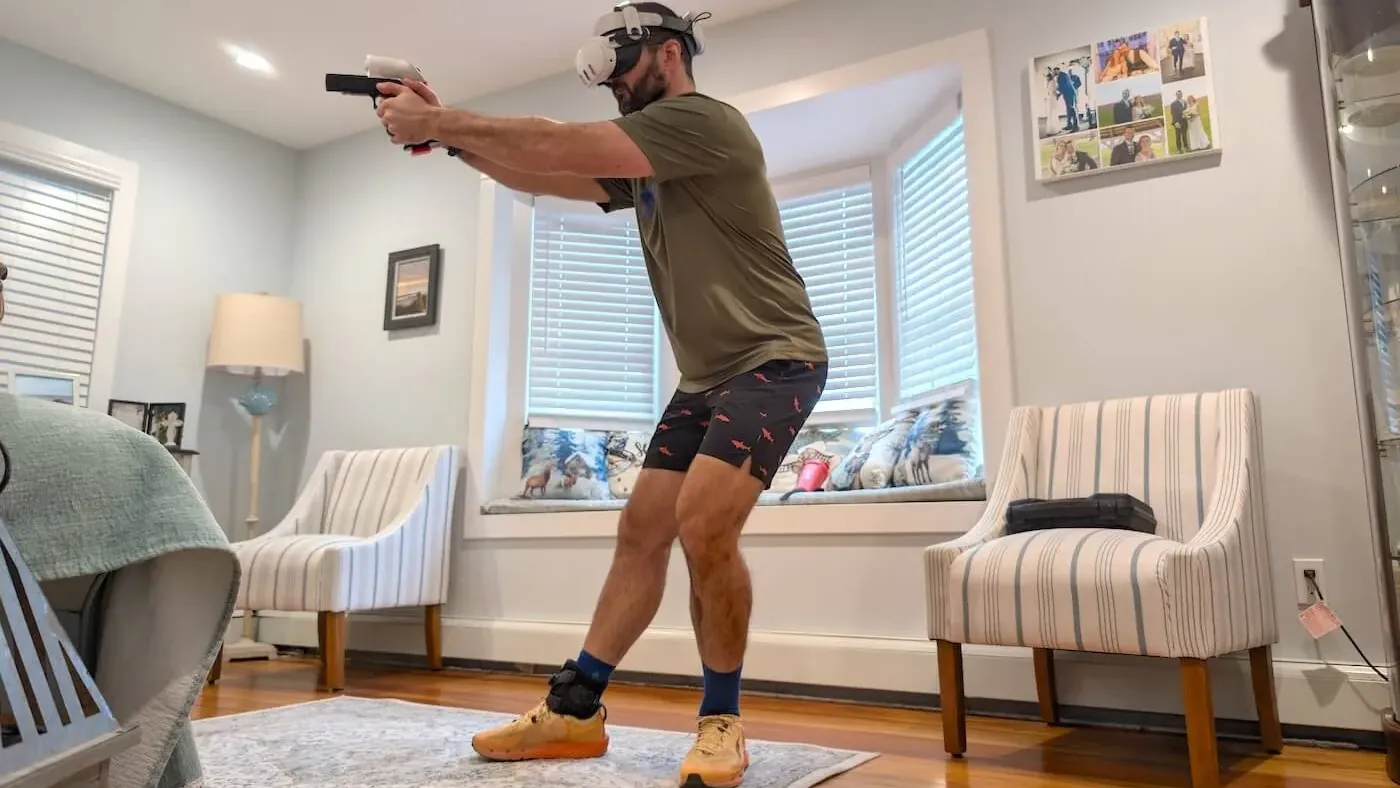
Ace XR (now also branded Ace Virtual Shooting) is a virtual shooting system with two parts: a physical handset that snaps around a Meta Quest controller, and training software that runs on the headset. The handset gives you weight, grip geometry, a tactile trigger with a real break and reset, a working magazine release, and 1913 rails for a light or optic. In the headset, you see your pistol in your hands, aligned to where the handset actually is.
Reviewers who have put the system through its paces describe it as a legitimate marksmanship and competition simulator rather than a game. Gun Digest's hands-on look at VR handgun training with AceXR walks through the hardware costs and the 3D-printing community that has grown around it, and Shooting News Weekly's review of home VR training with Ace Virtual Shooting covers how the handset tracks with the Quest platform.
The defender's use case
Competitors use Ace XR for stage breakdowns, transitions, and par times. Defenders need something narrower and arguably more urgent: a clean draw, a repeatable grip, an acceptable first hit at 3 to 7 yards, reloads under pressure, and the judgment to know when not to shoot. Those are all trainable in VR, on a Tuesday night, in 15 minutes. The Ace defender training path is organized around those fundamentals rather than match speed.
Why VR Reps Transfer to the Range
Skill under stress is built by volume and feedback, not by occasional range days. VR gives you both.
Volume you can't buy at the range
A 15-minute Ace XR session can deliver more presentations from the holster than a typical hour at a public lane, where you're loading magazines, waiting on a cold range, and policing brass. Three short sessions a week adds up to hundreds of draws per month. Motor patterns are built by repetition spaced over time, and spacing short sessions across the week beats one long cram session — a finding that holds across motor-skill research and is the same reason musicians practice daily rather than for five hours on Saturday.
Feedback on every shot
Dry fire at home is valuable, but it is nearly blind. You cannot see where the muzzle was at the break, and you cannot time yourself reliably without extra gear. Ace tracks shot placement, split times, and draw-to-first-shot, so a flinch or a trigger-press error shows up as data instead of a guess. That turns practice into diagnosis: if your first hits drift low-left, you know it's grip and trigger, not ammo or the gun.
Decision-making, not just marksmanship
Real defensive encounters are decision problems first and shooting problems second. Scenario-based VR lets you rehearse scanning, identifying a threat, moving to cover, and — critically — choosing not to fire. Law enforcement and the military have used simulators for exactly this reason for decades, because judgment reps are expensive and risky to stage live. Running them in a headset is cheap and repeatable, which is why Ace maintains dedicated LE/MIL training programs alongside its consumer product.
A Weekly Ace XR Plan for Home Defense Shooters
Short and consistent beats long and sporadic. Here is a realistic week that fits around a job and a family.
- Monday — 12 minutes: Draw to first hit at 5 yards. Standard: identical grip every rep, all hits in the A-zone.
- Wednesday — 15 minutes: Target transitions and multiple threats. Standard: eyes lead the gun, no makeup shots.
- Friday — 12 minutes: Reloads. Run the mag release and reload until the motion happens without thinking about it. A tap-rack or a real stoppage stays on the pistol.
- Weekend — 20 minutes: Low-light and scenario drills. Standard: scan, decide, and fire only when justified.
Drill the first three seconds
Most defensive encounters are decided fast and close. Weight your training toward the opening three seconds: recognize, draw, build grip, get an acceptable sight picture, press. Set a par time, miss it, shorten it, and repeat. Chasing a 1.5-second draw on a bullseye is less useful than a 2.0-second draw that lands every time under a slightly rushed clock.
Train the standards you'd be judged by
Use repeatable benchmarks so progress is measurable month over month. Classic standards — a 5-yard, five-shot drill on a small target with a strict time limit, or a simple draw-and-one-hit par — are easy to replicate in VR and then verify with live fire. Log your numbers. If your VR times improve but your range times don't, something in your setup or your grip isn't matching reality.
Match the handset to your carry gun
Transfer improves when the tool in your hand feels like the one on your hip. Ace offers multiple pistol-pattern options, including a SIG P365-XMACRO COMP handset sized and weighted close to the real pistol. Pick the model closest to your everyday carry gun from the Ace handset lineup, and use the same holster position and cover garment you actually wear.
Set Up a Space That's Safe and Realistic
VR removes live ammunition from the equation, but it introduces its own hazards — you are moving with your vision occluded. Clear a play area with room to pivot and take a step, keep pets and kids out of it, and define your Quest boundary before every session. Meta's own Quest safety and setup guidance covers play-space requirements and guardian setup.
Two more rules that matter for defenders:
- No real firearms in the training area. Ever. Separate your dry-fire space from your VR space, and keep live ammunition in a different room. The industry's firearm safety rules don't pause because you're wearing a headset.
- Train in your real gear. Same belt, same holster, same concealment garment, same shoes. Equipment that only works in gym shorts is a false positive.
If you want to try the system before committing, Ace lists public demo locations where you can run a handset in person.
What Ace XR Can't Do — and How to Cover the Gap
Honest training requires honest limits. A VR handset does not recoil like a 9mm, so recoil management and true sight tracking under recoil still have to be built with live fire. It does not reproduce muzzle blast, brass, or the smell and noise that spike your heart rate. And it cannot certify that your actual carry gun and ammunition are reliable.
Use this split:
- VR, 3–4 times a week: draw, grip, trigger control, transitions, reloads, scanning, judgment.
- Live fire, once or twice a month: recoil control, zero confirmation, ammo and gun function, and verification of the standards you've been hitting in the headset.
- Formal instruction, once or twice a year: a qualified instructor who can see what you can't, plus legal and use-of-force education from a credible source in your state.
Treated that way, Ace XR isn't a substitute for the range. It's the thing that makes your range time worth more, because you show up with your mechanics already grooved and spend your ammo on what only ammo can teach.
Frequently Asked Questions
Do I need a specific headset to use Ace XR?
Yes. Ace runs on the Meta Quest platform. The Quest 3 and Quest 3S are the currently supported, in-production options; the Quest 2 also works but is no longer manufactured. The handset clamps around a Quest controller, so controller compatibility is what matters most. Check current requirements on the Ace support FAQs before buying a used headset.
Will VR training actually make me a better shooter with a real gun?
It builds the parts of shooting that are mechanical and cognitive: grip consistency, draw efficiency, trigger press, target transitions, scanning, and decision-making. Those transfer. Recoil management does not, which is why serious users pair frequent VR sessions with periodic live fire rather than replacing the range entirely.
How much space do I need at home?
Enough to extend both arms, pivot, and take a step in any direction without hitting furniture. A cleared 7-by-7-foot area is comfortable for most drills. Set your headset boundary every session, and remove anything with a sharp corner from the perimeter.
Is Ace XR worth it for someone who only owns one home-defense pistol?
That's arguably the strongest case for it. Shooters with one gun and limited range access are the ones who get the fewest reps. Hardware is a one-time cost measured against ammunition you'd otherwise burn, and the system removes the biggest barrier to practice — having to leave the house.
How often should I train to see progress?
Three short sessions a week, 12 to 15 minutes each, will produce visible change in draw time and first-shot accuracy within a month. Consistency matters more than session length. Track your numbers so improvement is measured, not assumed, and compare them against your live-fire results every month or two.