
Laser Dry Fire Block Builder
Answer six questions. Get a timed drill block with par times, pass/fail standards, your monthly rep volume, a two-week retest benchmark, and the exact skills your laser setup cannot measure.
Your block appears here: warm-up, primary focus drill, support drills, timed benchmark, monthly rep volume, and the gaps a wall target cannot cover.
Drill library used by this builder
- Grip Set + Press-Out (warm-up) — build the same grip index every rep, press out, break as the dot settles. Standard: identical grip and a still dot at the break.
- Laser Wall Drill — small aiming point on a scaled target at the distance your room actually allows. After the beam is zeroed to the sights, the laser stays inside that point at the break. Any dip, streak, or flick is a fail.
- Draw to First Hit — start from the position you shoot in matches. One hit. Par time.
- 3-Target Transition Ladder — three scaled targets. One hit each. Eyes lead the gun.
- Reload to Hit — one hit, dummy-mag reload, second hit. That second hit is a new presentation, not a split.
- Position work — only with enough depth that the muzzle stays on the safe direction. Enter, one or two separate presses, exit.
- Tight space — 90° turn only if the muzzle never leaves the backstop. No 180° turns in a house.
Safety protocol — run this every session
- All live ammo and loaded magazines leave the room.
- Clear the pistol twice — eyes and finger in the chamber and mag well.
- Insert the laser cartridge. Confirm it is the cartridge, not a live round.
- Dummy magazines only, and marked so they cannot be confused with live.
- One target. One safe direction. The muzzle does not leave that direction.
- End the session out loud. Remove the cartridge. No more presses in that room.
- Loading for carry is a separate procedure, in a different place, after dry fire is closed. Do not chain dry fire into load-and-holster.
Pick one dedicated dry-fire direction you would accept if a live round went. A purpose-built panel or dense exterior masonry is the standard. Do not use a bookshelf, interior wall, door, window, or hallway as a backstop. Rimfire: many .22s can be damaged by empty strikes. Check the manual. Replace worn cartridge caps.
What laser dry fire cannot measure
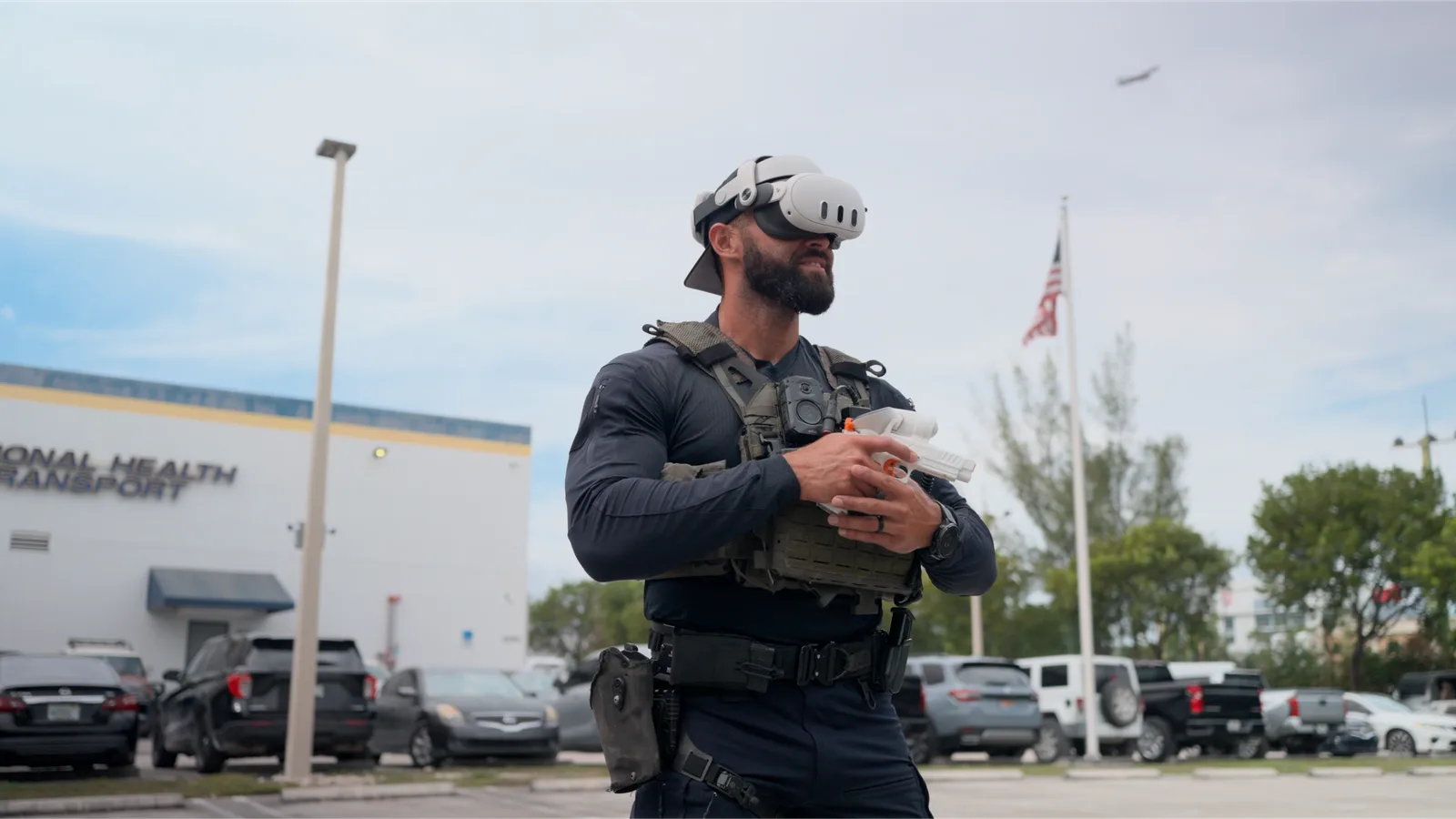
A laser does not recoil the gun. It also does not reset most real triggers. That means no recoil control, no shot-to-shot recovery, no real sight lift to call, no split times under recoil, and no full stage movement in a hallway. VR training on Meta Quest fills those gaps with scored drills, shot tracking, target transitions at distance, live-fire style scenarios, and leaderboards.
Par times and volume figures are standards to train against, based on your inputs, not a measured result.
Ammo costs money. Range trips cost time. Most competitive shooters have neither in unlimited supply, which is why laser dry fire has become a standard part of the training week for USPSA, SCSA, and IPSC shooters. Add a laser cartridge to an unloaded pistol, put a target on the wall, and every trigger press produces something ordinary dry fire never gave you: a visible point of impact.
That single change matters. Dry fire without feedback tells you the trigger broke. Laser dry fire tells you where the gun was pointed when it broke. Below is how the technology works, how to build sessions that actually transfer to live fire, where laser training runs out of road, and how to combine it with VR training so your practice covers the full skill set a match demands.
What Laser Dry Fire Training Actually Measures
A laser dry fire setup has three parts.
- A laser source. Either a laser training cartridge that drops into the chamber of your carry or competition pistol, or a purpose-built training pistol such as a SIRT that houses the laser internally.
- A target. Paper targets for visual-only feedback, reactive targets that light up or beep, or app-scored targets read by a phone camera.
- A scoring layer. Software that logs hit location, split times, and draw times so you can compare today's reps to last month's.
Independent testing outlets have put these systems through their paces; Gun Tests' evaluation of home laser training systems highlights how much of the value comes from drills that measure reaction time and hit placement rather than the laser itself. The laser is just the messenger. The measurement is the product.
The skills laser work builds fastest
Laser dry fire is strongest on the fundamentals that break down under speed:
- Trigger control. A dip, streak, or low-left (right-handed) or low-right (left-handed) at the break is information. It can be trigger push, grip pressure changing, or a flinch. In dry fire it is usually the press, not recoil anticipation.
- Grip consistency. Watch whether your dot lands in the same place from rep one to rep fifty. Drift means grip pressure is changing.
- Draw and presentation. Time from the start position you actually use in matches — wrists above shoulders, hands at sides, or from concealment. Those are different draws. Log consistency before you chase a hero time.
- Target transitions. Two or three targets on a wall, and you can see whether your eyes are leading the gun or chasing it.
What the laser actually measures
The laser shows muzzle direction at the break. That is the job.
It does not recoil the gun. After most dry presses on a real pistol, the trigger is dead until you rack or use a reset device. Do not log rack-to-rack times as splits. Do not call two presses on a still gun a pair.
- Laser cartridge: your real gun, holster, and trigger — usually one good press, then a rack.
- Reset trainer or Ace handset: press, reset, press, plus scoring.
- Live fire: recoil, sight lift, and real splits.
Zero the beam to your sights before you chase a standard. Chamber lasers do not sit on the sight line. Train the gun, not the offset.
Safety Rules That Never Bend During Dry Fire
Every negligent discharge in a living room started with someone who "knew" the gun was empty. The National Shooting Sports Foundation is explicit that even when dry firing an unloaded gun, you should never point the muzzle at an unsafe target.
Start with the backstop. Pick one dedicated dry-fire direction you would accept if a live round went. A purpose-built panel or dense exterior masonry is the standard. Do not use a bookshelf, interior wall, door, window, or hallway as a backstop.
Then build a protocol and run it the same way every session:
- All live ammo and loaded magazines leave the room.
- Clear the pistol twice — eyes and finger in the chamber and mag well.
- Insert the laser cartridge. Confirm it is the cartridge, not a live round.
- Dummy magazines only, and marked so they cannot be confused with live.
- One target. One safe direction. The muzzle does not leave that direction.
- End the session out loud. Remove the cartridge. No more presses in that room.
- Loading for carry is a separate procedure, in a different place, after dry fire is closed. Do not chain dry fire into load-and-holster.
One equipment note: many .22s can be damaged by empty strikes. As firearm storage specialists at Liberty Safe explain, rimfire designs can dent the chamber edge or firing pin when fired empty. Check the manual. Replace worn cartridge caps.
Build a Laser Dry Fire Session That Transfers
Volume without structure produces sloppy reps at speed. Structure beats volume. Here is a 20-minute block that competitors can run four days a week.
0–4: Calibration
Ten slow presses from low ready. No timer. If a clean press does not put the beam where the sights say, fix grip and trigger before you add speed.
4–12: Draw to first hit
Twenty-five draws on a random start. One press per rep. Rack to reset if the gun needs it. Chase a tight group of times, not one fast outlier.
12–18: Transitions
Three targets. One hit each, both directions. If the gun beats the eyes, the rep failed.
18–20: One cold run
One unrehearsed string. Score it honestly. Matches are cold. Train the cold start.
Stop when times open up or hits scatter. Track the numbers: trend lines beat memory, and they show when a grip or holster change actually worked.
Where Laser Systems Stop and VR Training Picks Up
The gap in most home programs is not fundamentals. It is context: movement, positions, unpredictable target arrays, and scoring pressure. That is where headset-based training earns its place next to the laser cartridge.
Movement and stage craft
A wall target will not teach movement, ports, or stage geometry. VR will. VR can build the stage, place the targets, and force the reload where you did not want it. Ace's drill library includes 100-plus practical shooting drills built for exactly that kind of problem solving, and our training resources for competitive shooters map those drills to USPSA, SCSA, and IPSC skill demands.
Hardware that feels like a pistol
Feedback only transfers if the interface does. The Ace handsets break and reset, run about 27–31 oz with a Meta Quest controller installed depending on model, and score the run. That covers press-reset-press, transitions, and movement a hallway laser cannot. They replicate the balance, grip, and magazine release of a real pistol, so draw strokes and reloads look like the ones you run at a match. It is still not recoil, and it is not force-on-force. In an NRA Shooting Illustrated review of the Ace simulator, the reviewer described the system as delivering the shooting-range experience minus recoil — a fair summary of both the strength and the boundary of any non-recoiling trainer, laser or virtual.
Scoring, tracking, and leaderboards
Laser targets score hits. VR scores runs. Shot tracking, hit-factor style scoring, and leaderboards create the pressure that turns a comfortable practice rep into something closer to match stress. Use VR for scored drills, target ID, and stage flow. Confirm recoil on the range. Shooters who want to see how that plays out for other users can browse verified Ace member reviews.
A Weekly Plan That Combines All Three
Use each tool for what it does best:
- Traditional dry fire — draw, reload, and gun handling reps. Daily, 10 minutes.
- Laser dry fire — trigger control and hit-location feedback. 3–4 sessions per week, 20 minutes.
- VR training — movement, stage design, transitions, scored pressure. 2–3 sessions per week, 20–30 minutes.
- Live fire — recoil, sight tracking, confirmation. Frequency depends on the class you want. Treat 1–2 trips a month as the minimum verification for an ammo-limited shooter, not a plan to move up.
The pattern that works: build the mechanics at home, validate them under recoil at the range, then take what the range exposed back into your laser dry fire and VR sessions. Every range trip becomes a test rather than a practice session — which is exactly how the ammo budget starts producing results instead of just noise.
Frequently Asked Questions
Is laser dry fire better than regular dry fire?
It is better at one specific job: showing you where the muzzle was pointed at the moment the trigger broke. That feedback shortens the correction loop on trigger control and grip. Regular dry fire still wins on convenience and pure gun-handling volume, since you can run it anywhere without setting up a target or an app. Most serious shooters use both.
Does a laser cartridge let me train pairs and splits?
No. Most pistols need the slide run to reset. Train one honest press on your match gun. Train reset, cadence, and movement on a reset trainer or in VR. Prove it under recoil live.
Will a laser training cartridge damage my pistol?
Most quality cartridges include a polymer or rubber striking surface that acts as a snap cap, and the majority of modern centerfire pistols handle dry fire without harm. Rimfire firearms are the exception and can be damaged by empty strikes. Check your owner's manual, and replace cartridge caps when the strike surface shows heavy wear.
How many reps should I do per session?
Quality decides the number, not the clock. Twenty to thirty focused draws plus a few transition drills beats 200 sloppy presses. Stop when your times start rising or your hits start scattering — that is fatigue writing bad habits into muscle memory.
Can VR replace laser dry fire entirely?
No, and it does not need to. Laser dry fire uses your actual pistol, holster, and trigger, which keeps your hands honest on the gun you compete with. VR adds movement, stage variety, unlimited target arrays, and scored runs you cannot build in a bedroom. Running both covers more of the skill set than either alone.
Does any of this actually improve live-fire scores?
Structured non-live-fire practice consistently improves the components you can measure at home — draw time, transition speed, and trigger control — and those components carry directly into match performance. Recoil management is the piece that still requires live rounds, so keep range trips in the plan and treat them as verification.