
Home Pistol Accuracy Session Planner
Range time is expensive. Structured reps at home are free. Answer five questions and get a timed dry-fire session plan built around your biggest accuracy problem, your space, and the gear you already own.
Every drill this planner can assign
- Wall drill, trigger press isolation. Sights aligned on a blank wall. Press straight to the rear with zero sight movement. Fixes low-left hits caused by pushing the trigger or milking the grip.
- Grip rebuild and press-out. Build the same grip from the same starting position every rep, thumbs forward, support hand driving pressure. Fixes shot-to-shot inconsistency.
- Call-your-shot sight focus. Break the shot and say where the sight or dot was at the break before you look. Fixes sight alignment and shot calling.
- Ball and dummy randomization. Snap caps mixed into the routine expose flinch and recoil anticipation instantly.
- Balance drill. A casing or coin on the front sight stays put through the press. Fixes muzzle dip.
- Draw to first sight picture on par. Presentation from ready or holster against a par time. Fixes slow first shots.
- Target transitions. Eyes lead, gun follows, stop the gun on the target, not through it. Fixes lag between targets.
- Diagnostic circuit. Rotates all five fundamentals so you can find the error before you spend money on ammo.
- Tracked VR reps. Scored drills with shot tracking that show where the shot actually landed, plus recoil recovery and split times dry fire cannot measure.
The five fundamentals every plan drills
Grip. Stance and natural point of aim. Sight or dot alignment. Trigger control. Follow-through and reset. Accuracy at home is built by repeating these five under control, then verifying them with feedback.
Range time is expensive, and most defenders get to shoot maybe once a month. That is not enough repetition to build a reliable draw, a clean trigger press, or the confidence to make a hard shot under stress. The good news: the biggest gains in handgun performance come from skills you can rehearse in your living room. Learning how to improve pistol accuracy at home is less about gear and more about structured, safe, repeatable practice.
This guide covers what actually transfers to the range: a safe setup, the fundamentals worth drilling, a 15-minute session you will finish, and how VR training closes the gaps dry fire leaves open.
Why Home Practice Drives Real Accuracy Gains
Accuracy is mostly a stability problem. If the muzzle moves while the trigger breaks, the shot moves. Everything else — stance, breathing, sight picture — supports that one moment. That is why instructors keep pointing shooters back to dry fire. The NRA's competitive shooting publication makes the case plainly in its breakdown of why dry-fire practice matters: it lets you rehearse trigger control and sight alignment without ammo cost, recoil, or blast masking your mistakes.
Home practice also wins on frequency. Ten focused minutes, five nights a week, gives you far more quality repetitions than a single monthly range trip. Short, spaced sessions are how motor patterns get encoded. Even mental rehearsal contributes: research on mental representation and motor imagery training shows that imagined practice can sharpen the internal blueprint of a skill alongside physical repetition. Visualizing a clean press is not a substitute for reps, but it is not wasted time either.
What home practice cannot do is teach recoil control or confirm where rounds land. So the honest answer to how to improve pistol accuracy at home is a split plan: build mechanics at home, verify them with live fire.
Build a Safe Home Training Space First
No drill matters if the setup is unsafe. Treat this like a pre-flight checklist every single session.
Clear the Gun, Clear the Room
- Remove the magazine. Lock the slide back. Visually and physically check the chamber — twice.
- Move all ammunition and loaded magazines to a different room. Not a different drawer. A different room.
- Use dummy rounds or snap caps if your practice includes malfunction or reload work.
- Announce the start and end of your session out loud. It sounds silly. It prevents the worst mistake in the sport.
Pick a Real Backstop and a Real Target
Point your practice at something that would stop a round: an exterior wall with a masonry backer, a loaded bookshelf, a dedicated ballistic backstop. Never a hallway, a shared wall, or a floor above a finished basement. Then scale your target. A 1-inch dot at 10 feet covers the same visual angle as a 3-inch circle at 10 yards, so small targets up close force honest sight alignment in a small room.
The Five Fundamentals Worth Drilling at Home
1. Grip That Stays Consistent
Grip is the cheapest accuracy upgrade available. Get the pistol high in the web of your dominant hand, in line with your forearm. Fill every gap with the support hand, thumbs forward, support-hand wrist cammed slightly toward the target. Then check it: build the grip, close your eyes, present, and open them. If the sights are off-center, your grip is doing the work your arms should not have to do. Fifty grip builds a night, and the pistol starts arriving on target already aligned.
2. Trigger Control Under a Coin
Balance a coin or an empty casing on the front sight, then press the trigger. If it falls, you are moving the gun. Press straight to the rear, take up slack deliberately, break the shot, then hold the trigger back for a full second before resetting. That pause teaches follow-through, which is where most defenders lose shots two and three.
3. Sight Tracking and Target Transitions
Put three small targets on the wall at different heights. Drive your eyes to the next target first, then let the gun follow. Stop the muzzle — do not swing past and correct. Transitions are a vision skill before they are a gun skill, and they cost nothing to practice at home.
4. Draw and Presentation From Concealment
Defenders shoot from the holster, not from a bench. Practice the draw in the clothes you actually wear: clear the cover garment, get a full firing grip before the pistol moves, press out on a straight line, confirm the sights. Slow and correct beats fast and sloppy. Speed comes from removing wasted motion, not from rushing.
5. Reloads and Malfunction Clearing
With snap caps, run emergency reloads and tap-rack drills until your hands know where the magazine pouch lives. These are pure mechanics — ideal for home reps, and they keep a mid-string stoppage from wrecking your accuracy under pressure.
A 15-Minute Home Accuracy Session You Will Finish
Structure beats motivation. Run this on a timer:
- Minutes 0–2: Safety check. Unload, verify, ammo out of the room, announce the start.
- Minutes 2–5: 40 grip builds and presentations. No trigger press. Sights must arrive aligned.
- Minutes 5–9: 30 slow trigger presses on a 1-inch dot with the coin drill. Reset between each.
- Minutes 9–12: Transitions across three targets, five passes. Eyes lead.
- Minutes 12–14: Ten draws from concealment, then five reloads.
- Minute 14–15: Log it. Reps completed, what felt wrong, one thing to fix tomorrow.
Stop while the reps are still clean. Sloppy repetitions build sloppy habits, and quitting on a good rep keeps the pattern correct.
Where Dry Fire Stops — and VR Training Takes Over
Dry fire has three hard limits. There is no shot feedback, so you never learn where the round would have gone. There is no recoil, so you never build a control loop for shot two. And it gets boring fast, which is why most home programs die in week three.
That is exactly the gap simulation fills. Studies of marksmanship in immersive headsets, including research on sensorimotor learning during a marksmanship task in virtual reality, show that shooters measurably improve within VR environments and that precision shooting is a well-suited task for studying visually guided motor learning. Simulators have been standard in military and law enforcement training for decades for the same reason: reps are cheap and feedback is immediate.
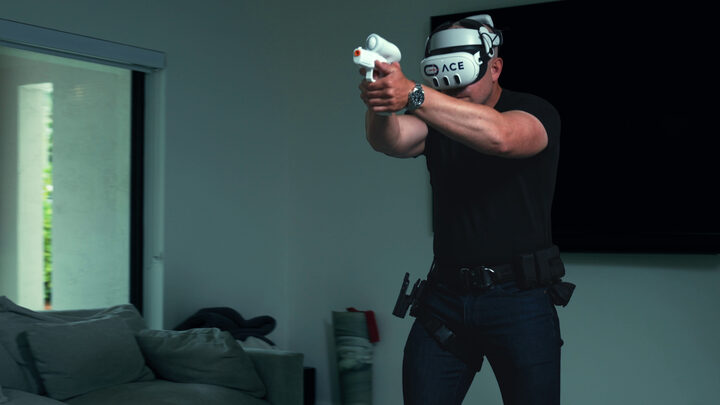
Ace XR was built around that principle. Weighted VR handsets mirror real pistol dimensions and trigger feel on a Meta Quest headset, so grip, presentation, and trigger control carry over instead of staying in the game. You get shot tracking on every round, timed drills, target transitions, and live-fire scenarios you cannot legally or safely stage in a house. For home defense and concealed carry shooters, that means practicing decision-making and movement — not just standing still and pressing a trigger.
Use both. Dry fire for pure mechanics and holster work. VR for feedback, stress, movement, and volume. Live fire to validate.
Measure It, or You Are Just Guessing
Accuracy improves when it is scored. Pick two or three benchmarks and repeat them weekly so you can see trend lines instead of relying on memory.
- Group size at a fixed distance. Same target, same yardage, same round count, every range trip.
- First-shot time from concealment. Track draw-to-hit, not just draw speed.
- Split and transition times. VR shot tracking and leaderboards make this trivial to log at home.
- Reps per week. Consistency predicts progress better than any single good day.
Write it down. A one-line log after each session — reps, drill, what broke down — turns scattered practice into a program. If you want to see how other shooters structure their weeks, the Ace Insights blog publishes drills, training breakdowns, and competition-focused programming you can borrow directly.
Improving pistol accuracy at home is not complicated. Safe setup. Correct fundamentals. Short daily sessions. Objective feedback. Do that for a month and your next range trip will show it on paper.
Frequently Asked Questions
How much dry fire do I need to see accuracy gains?
Ten to fifteen minutes, four or five days a week, is enough for most defenders to notice a difference within a few weeks. Frequency matters more than session length. Two hours on a Sunday builds less durable skill than short, focused reps spread across the week, and long sessions tend to degrade into low-quality repetitions.
Will dry firing damage my pistol?
Most modern centerfire handguns are designed to tolerate extensive dry fire, and manufacturers routinely recommend it as practice. Rimfire pistols are the main exception, since the firing pin can strike the chamber edge. Check your owner's manual, and use snap caps if the manufacturer advises it.
Can VR training really replace range time?
No — and it should not. VR replaces the volume of repetition that range time cannot afford, and it adds feedback dry fire cannot give. You still need live fire to confirm zero, manage real recoil, and validate your mechanics under blast and muzzle rise. The most effective plan pairs frequent home reps with regular live-fire verification.
What is the single fastest fix for a shooter who keeps hitting low and left?
Usually grip and trigger finger placement, not sights. Low-left hits for a right-handed shooter typically mean the trigger finger is pushing the muzzle as it presses, or the support hand is not locked in. Run the coin-on-the-front-sight drill and the eyes-closed presentation check. If the coin stays put and the sights arrive centered, the problem was mechanics.
How much space do I need to improve pistol accuracy at home?
Not much. A 10-foot lane with a safe backstop covers grip, trigger, transitions, draw work, and reloads. Scale your targets down so short distances still demand precise alignment. If you want to try a headset before committing, Ace XR lists demo locations where you can run drills in person first.