
Build Your Ace Training Week
The "ace game" people find in search is Ace Virtual Shooting — VR firearms training, not an arcade shooter. Answer five questions and get a day-by-day drill plan you can run in 10–30 minutes a session, plus your weekly rep volume and what that same round count would cost in live ammo.
Your plan appears here: a named training block, each training day with its drills and minute-by-minute breakdown, your estimated weekly and monthly rep volume, the live-ammo cost of that same round count, and the live-fire validation step that proves the transfer.
Drill library used in every plan
- Grip & Presentation — same firing grip every rep, full extension, sights aligned on arrival.
- Trigger Control — press to the break with zero sight movement, then reset and repeat.
- Precision Accuracy — smaller targets at distance; call every shot before you see the hit.
- Draw to First Shot — holster to first hit on a consistent draw path, no dip, no over-travel.
- Target Transitions — eyes lead the gun; two targets, then three, then wide spreads.
- Reload Under Time — slide-lock and in-position reloads, indexing the magwell without looking.
- Shooting on the Move — enter and exit positions shooting, stable upper body, soft knees.
- Live-Fire Scenario Run — unknown target order and time pressure: shoot, assess, reload, move.
Volume and cost figures are estimates based on your inputs and standard drill pacing, not a measured result.
Type "ace game" into a search bar and you will find something that does not really behave like a game at all. Ace Virtual Shooting runs on a Meta Quest headset, but the reps you take inside it are built around the same fundamentals a good instructor drills on a live range: grip, trigger control, sight picture, target transitions, and repeatable draws. For defenders — people who carry every day or keep a pistol for home protection — that distinction matters. You are not chasing a high score. You are building muscle memory you can trust at 2 a.m. in a dark hallway.
This guide breaks down what Ace Virtual Shooting actually is, what the research says about skill transfer from virtual training, and how to build a weekly practice plan that makes your next range trip count.
What Ace Virtual Shooting Is — and What It Isn't
Ace is a virtual shooting simulator, not an arcade shooter. It has three parts:
- A Meta Quest headset (Quest 2, 3, or 3S), which handles tracking and display.
- An Ace handset that snaps onto a Quest controller and replicates the size, weight, grip angle, and trigger pull of a real pistol. The lineup includes officially licensed SIG SAUER, CZ, and Staccato models, so you can train with a shape that matches what you carry.
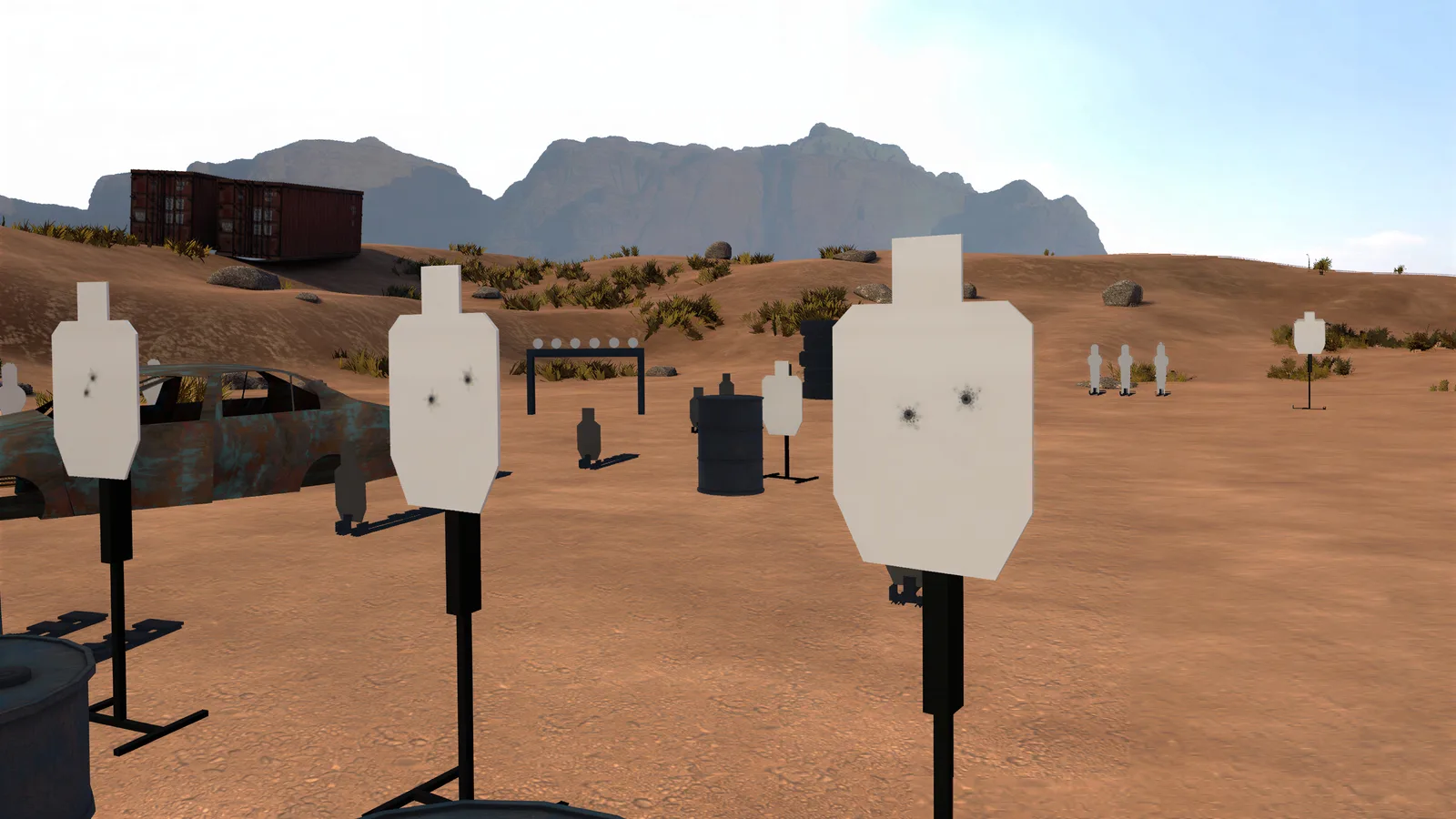
- The Ace software, with 100+ drills, courses of fire, scenarios, and shot-by-shot performance data.
The ACE app listing on the Meta Quest store makes the requirement clear: the handset and membership are what turn the headset into a training tool rather than a novelty. Without a weighted handset, you are waving a plastic controller and learning the wrong grip.
Why "game" is the wrong mental model
Video games reward reaction speed and pattern memorization. Ace rewards process: a clean presentation from concealment, a sight picture that settles before the trigger breaks, and a trigger press that does not steer the gun. The scoring, leaderboards, and mini-games exist to keep you coming back — and repetition is exactly the point. A drill you actually run 200 times beats a perfect plan you skip.
Does Virtual Training Actually Transfer to Real Shooting?
This is the fair question every serious shooter asks, and the honest answer is: transfer depends on how closely the training matches the real task.
A U.S. Navy study comparing simulator-based instruction to standard marksmanship training found that recruits trained on the simulation program improved live-fire marksmanship performance more than the standard course, in less instructional time. In sport science, a systematic review of virtual environment training concluded that transfer to real-world sporting performance is supported but depends heavily on how faithfully the simulation reproduces the physical task — the closer the tool, the cues, and the movement, the better the carryover.
That is the practical case for a weighted, trigger-accurate handset over a generic controller, and for simulators that track where your shots land. Traditional dry fire is valuable and free, but its known weakness is feedback: without a scored impact, you are guessing whether your press was clean. Independent testing groups have struggled to measure marksmanship gains from dry fire alone, which points to the same conclusion — reps plus measurable feedback beat reps alone.
Three rules keep your virtual reps honest:
- Train with a handset that matches your carry gun's size and controls as closely as possible.
- Use the same grip, stance, and draw sequence you would use live. Sloppy reps groove sloppy habits.
- Confirm on a live range. Virtual training builds the skill; recoil management and ammunition confidence still require real rounds downrange.
A Defender's Weekly Plan Inside Ace Virtual Shooting
Defenders need a different diet of drills than competitors. Competition rewards speed on known stages; defense rewards a fast, correct first shot under pressure, in bad light, from concealment. Ace's training track for defenders is built around exactly those problems.
Here is a repeatable four-day structure that fits in 15 to 20 minutes per session:
Day 1 — Draw and first shot
Twenty-five slow presentations from concealment, focusing on a consistent grip on the initial touch. Then 25 at working speed. Watch your first-shot time and your hit location, not just your hits.
Day 2 — Trigger control at distance
Precision drills at 15 to 25 yards. Distance magnifies trigger errors that a close target hides. If your groups drift low-left, the data will show it before your next box of ammo does.
Day 3 — Transitions and movement
Multiple targets, with deliberate visual transitions — eyes first, then the gun. Add lateral movement and shooting from unconventional positions. This is where VR clearly beats a static dry-fire wall.
Day 4 — Scenarios and low light
Run realistic, low-light home-defense scenarios that force decisions: identify, move, communicate, and only then shoot. Then finish with one scored drill you repeat every week as a benchmark.
Log the benchmark number. A single repeated drill — say, a 7-yard draw to one shot — is the cleanest way to see whether the training is working over 8 to 12 weeks.
The Numbers That Make Home Reps Worth It
Two constraints keep most defenders from practicing enough: time and ammunition cost. Tracked retail pricing shows practice-grade 9mm FMJ hovering in the mid-$0.20s to about $0.30 per round, and defensive hollow points run far higher. A modest 200-round practice session is $50 to $60 in ammunition alone, before range fees, targets, drive time, and the hour you lose getting there and back.
Now compare that to the Ace economics. A single at-home session costs you nothing per shot, which changes how you train. You stop rationing repetitions. You run the draw 60 times instead of six. You can shoot at 6 a.m. before work or at 10 p.m. after the kids are asleep, in a space about the size of a living room, with no ammunition in the house's training loop at all.
That volume is the real advantage. Skill is built through many correct repetitions spaced over time — which is difficult when each rep has a price tag and a 40-minute commute attached to it. Ace members can also stack value through the military and first responder discount, and annual plans have included the handset, which removes most of the up-front hardware cost.
How to Set Up for Productive Reps
A few setup details separate people who train from people who bought a headset.
- Clear a real space. Aim for roughly 6 by 6 feet of open floor so you can move, pivot, and shoot from cover without clipping furniture.
- Match your gear. Choose a handset that mirrors your carry pistol's dimensions and controls, and configure the in-app optic and sights to match your real setup. Browse the full handset lineup before you buy.
- Wear your real belt setup. Same holster position, same cover garment. Training the draw against a different rig teaches a draw you do not own.
- Keep sessions short and frequent. Four 15-minute sessions a week outperform one 90-minute marathon for motor learning.
- Review your metrics every session. Accuracy, first-shot time, and splits tell you what to fix next. Trending numbers, not single good runs, show real progress.
Not sure if VR training fits how you shoot? Try it in person first — Ace lists demo locations where you can put on a headset and run a drill before committing.
Where Ace Virtual Shooting Fits in a Complete Training Program
Treat Ace as your volume builder, not your only tool. The blend that works for most defenders looks like this: virtual reps several times per week for fundamentals, presentations, transitions, and decision-making; live fire once or twice a month to validate zero, manage recoil, and confirm your carry ammunition; and formal instruction a couple of times a year to catch the errors you cannot see yourself.
Do that consistently and the payoff shows up where it counts — a faster, cleaner first shot, fewer wasted rounds on the range, and the confidence that comes from having already rehearsed the moment you hope never arrives. That is a far better return than any score on a leaderboard.
Frequently Asked Questions
Is Ace Virtual Shooting a real training tool or just a shooting video game?
It is a training simulator. Drills are designed by competitive and LE/MIL experts, and every shot is tracked so you get accuracy, timing, and consistency data. The weighted handset with a realistic trigger is what separates it from a controller-based shooting game.
What equipment do I need to start?
A Meta Quest 2, 3, or 3S headset (sold separately), an Ace handset that clips onto a Quest controller, and an Ace membership. That's it — no ammunition, no range fee, and no dedicated room.
Can VR training really improve my live-fire shooting?
Research on simulator-based marksmanship and virtual motor-skill training shows meaningful transfer when the simulation closely matches the real task. That is why handset weight, grip angle, and trigger feel matter, and why you should still confirm skills with live fire.
How much space do I need at home?
Most drills work in about 6 by 6 feet of clear floor. You need enough room to present the pistol, pivot, and take a step or two without hitting furniture or walls.
Is it useful for concealed carry and home defense specifically?
Yes. Defender-focused content includes draws from concealment, low-light scenarios, movement, and decision-making under time pressure — the skills that decide real defensive encounters, not just paper scores.