
Dry Fire Rep Planner
Build a week of dry fire that actually moves your classification. Pick your discipline, your level, the time you really have, and the skill costing you the most points. You get a day-by-day plan, rep volume, and par times to beat.
Safety protocol first. Unload. Remove all ammunition from the room. Verify the chamber twice. Aim at a safe backstop wall. Announce the end of the dry fire session out loud, then reload away from the training area.
Your plan appears here. Plans run 3 to 6 days per week at 10 to 30 minutes per session, weighted toward one of five skills: draw speed, target transitions, trigger control, reloads, or movement and entries. Every plan returns weekly rep volume, one focus per day, a scored recall day, par-time targets for your level, and the measurement gaps in your current setup.
Drill library used by this planner
- Draw speed: draw to first shot at 7 yards; draw to a 3x5 headbox at 10 yards.
- Target transitions: three-target sweep measured per target; wide-to-tight transition pairs.
- Trigger control: wall drill press-outs with no sight movement; sight-tracking doubles with called shots.
- Reloads: standing reload with eyes on target; reload while moving between positions.
- Movement: position entry with the gun up early; exit on the last shot.
Par times shown are training targets, not scores. Dry fire builds the motion. A timer, a hit call, and a record of every rep are what turn the motion into measurable speed.
Ask any A-class USPSA shooter how they got fast, and the answer is rarely “more range time.” It's reps. Thousands of them, most performed at home with an unloaded gun, a timer, and a wall. Dry fire training is the quiet engine behind almost every competitive shooter's improvement curve, and it's available to you tonight, in your living room, for the cost of ten minutes.
The shooting sports are growing fast. USPSA and Steel Challenge crossed 40,000 members in April 2025, an all-time high for the organization. More shooters means deeper classifier fields and tighter margins at every match. The competitors moving up aren't the ones burning the most ammo. They're the ones who practice most consistently between matches.
Why Dry Fire Beats Range Days for Building Skill
A typical range session gives you maybe 200 to 300 rounds over 90 minutes, and a large share of that time is spent loading magazines, taping targets, and waiting on a cold range. The actual skill-building portion — draw, presentation, sight confirmation, trigger press — might total a few minutes of focused work.
Dry fire flips that ratio. Ten focused minutes at home can produce 100+ quality draws or 200+ trigger presses with zero downtime, zero ammo cost, and no cease-fires. You also get to practice things most public ranges prohibit outright: drawing from a holster, movement between positions, and rapid target transitions.
Short, frequent sessions outperform marathon practice
This isn't just gym-talk. A meta-analysis of hundreds of experiments on distributed versus massed practice found that spacing learning episodes apart consistently produces better retention than cramming the same total practice into one block. For shooters, that means five 10-minute sessions across a week will beat a single 50-minute grind — and it's far easier to actually do.
Motor patterns are built by clean, repeatable reps performed while you're fresh. Once your grip gets sloppy or your eyes stop tracking the front sight, you're rehearsing errors. Stop the session. That's the entire discipline.
Dry Fire Safety Rules You Do Not Bend
Every serious dry fire program starts with a hard safety protocol. The NRA's shooting sports guidance on dry-fire practice is blunt about the basics, and they're worth writing on an index card and taping to your practice wall:
- Unload the firearm completely. Magazine out, chamber checked visually and physically, then checked again.
- Remove all live ammunition from the room. Not the drawer. Not your pocket. Out of the room.
- Use a designated dry fire area with a safe backstop — an interior wall backed by masonry, a loaded bookshelf, or a purpose-built backstop. Never point at a wall someone could be standing behind.
- Announce the end of the session out loud. “Dry fire is over.” Then reload away from your practice area. Negligent discharges during dry practice most often happen after the session ends, when a shooter reloads and decides to take “one more rep.”
- Check your firearm's manual. Most modern centerfire pistols tolerate dry fire indefinitely; many rimfires do not without a snap cap.
The Four Skills Dry Practice Develops Best
1. Grip and presentation
Your grip is set before the gun leaves the holster, and it either works or it doesn't by the time the sights hit the target. Dry fire lets you rebuild that draw stroke in slow motion, then compress it. Work the draw at 50 percent speed until the sights arrive flat and centered every single time, then add pace in small increments.
2. Trigger control
Nothing exposes a bad trigger press like a dry gun. With no recoil to hide behind, any dip in the sights at the break is 100 percent you. Balance a spent case on the front sight, press, and see if it stays. Then do it 50 more times.
3. Target transitions and visual patience
Fast shooters aren't pulling the trigger faster — they're moving their eyes faster and shooting the instant the sights arrive. Set up multiple scaled targets around a room at varied heights and distances, and drill eyes-first transitions. This is the single highest-return dry fire skill for practical shooting disciplines.
4. Reloads and manipulations
Magazine changes, malfunction clearances, and position entries are pure mechanical repetition. They're also the easiest place to find a half-second at a match.
Where Traditional Dry Fire Falls Short
Here's the honest limitation: a wall doesn't score you. Traditional dry fire gives you no confirmation of where the shot would have landed, so a rep that felt fast might have been a mile off the A-zone. Shooters also quit because the work is repetitive and progress is invisible from week to week.
That measurement gap is exactly why the shooting world has moved toward instrumented practice — laser cartridges, shot timers with par times, and increasingly, VR training. Research on immersive VR has repeatedly demonstrated transfer of complex skills to real-world tasks, with VR-trained participants outperforming those who trained with non-interactive methods. The mechanism is simple: an immersive environment forces the same visual search, timing, and decision-making that the real task demands.
What VR adds to a dry fire routine
- Shot tracking on every rep. You see hits, misses, and split times, so you know whether speed cost you accuracy.
- Full stages instead of a blank wall. Movement, multiple arrays, and steel — the parts of a match a hallway can't simulate.
- Scored drills and leaderboards. Measurable progress week over week keeps shooters training when motivation dips.
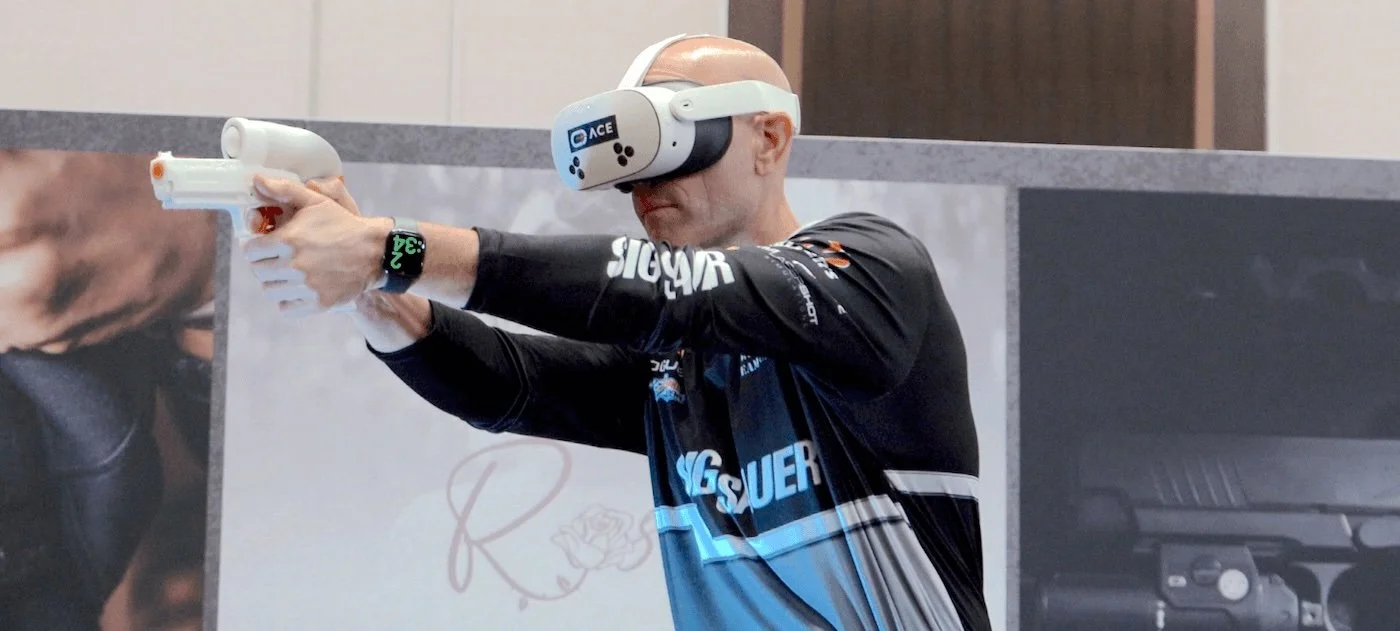
- Weighted handsets. Realistic mass and trigger feel matter; the closer the input device is to your carry or competition gun, the more the muscle memory carries over. Ace XR's VR handsets are built around that principle.
The right approach isn't VR instead of dry fire — it's VR as the scored, dynamic layer on top of your fundamentals work. Competitive shooters using structured VR practice for USPSA, SCSA, and IPSC typically keep a short mechanical dry fire block for grip and trigger, then move into VR for transitions, stage planning, and pressure reps.
A Weekly Dry Fire Plan You Can Actually Follow
Consistency beats intensity. Here's a five-day structure that fits around a job and averages under 15 minutes a day.
- Monday — Draw work (10 min). 30 draws to first sight picture on a par time. Reduce the par by 0.05 seconds only when you hit it clean five times in a row.
- Tuesday — Trigger control (10 min). 50 slow presses on a small target, sights must not move. Then 25 at speed.
- Wednesday — Transitions (15 min). Four-target array, eyes-lead drills, then add a reload between arrays.
- Thursday — Scored VR or laser session (15-20 min). Run full stages with hit feedback and compare times to last week.
- Friday — Weak-side and positions (10 min). Strong-hand-only, support-hand-only, kneeling, and around barricades.
Track everything. A cheap notebook with date, drill, par time, and a one-line note about what broke down is more valuable than another gadget. Review it before every match.
Common mistakes that waste your reps
- Practicing without a timer. Without a clock, you default to comfortable speed, and comfortable speed doesn't improve.
- Going too fast, too early. Speed built on a broken grip is a plateau, not progress.
- Skipping the follow-through. Call your shot on every rep, even dry.
- Training only what you're good at. Your worst skill sets your match score.
Dry fire training is the cheapest performance upgrade in the shooting sports — and the one most shooters abandon by week three because they can't see progress. Fix the feedback problem and the habit takes care of itself. If you want to see scored VR drills before committing, Ace XR lists in-person demo locations, and more training breakdowns live on the Ace Insights blog.
Frequently Asked Questions
How long should a dry fire training session be?
Ten to fifteen minutes, five days a week, beats one long weekly session. Research on distributed practice shows spaced repetition produces better retention than massed practice, and short sessions keep every rep clean. Stop the moment your grip or focus degrades.
Will dry firing damage my gun?
Most modern centerfire pistols and rifles are designed to tolerate extensive dry fire without damage, but rimfire firearms generally should not be dry fired without snap caps because the firing pin can strike the chamber mouth. Always check your manufacturer's manual first.
Can dry fire training replace live fire?
No. Dry fire builds grip, draw, trigger control, transitions, and manipulations, but it cannot teach recoil management or confirm real point of impact. The proven model is frequent dry practice at home with periodic live-fire sessions to validate what you've built.
How is VR dry fire training different from laser or snap-cap practice?
Laser and snap-cap practice work well for static fundamentals but don't score full stages. VR adds shot tracking, movement, multiple target arrays, and leaderboards, so you get measurable feedback on speed and accuracy in the same rep — closer to match conditions than a wall drill.
How soon will I see results from dry practice?
Most shooters notice a faster, more consistent draw and a cleaner trigger press within two to three weeks of daily 10-minute sessions. Timed, tracked drills make that improvement visible, which is the difference between a habit that sticks and one that fades.